
A life carefully told
Connect the scientific work, wartime service and later remembrance without erasing collaborators.
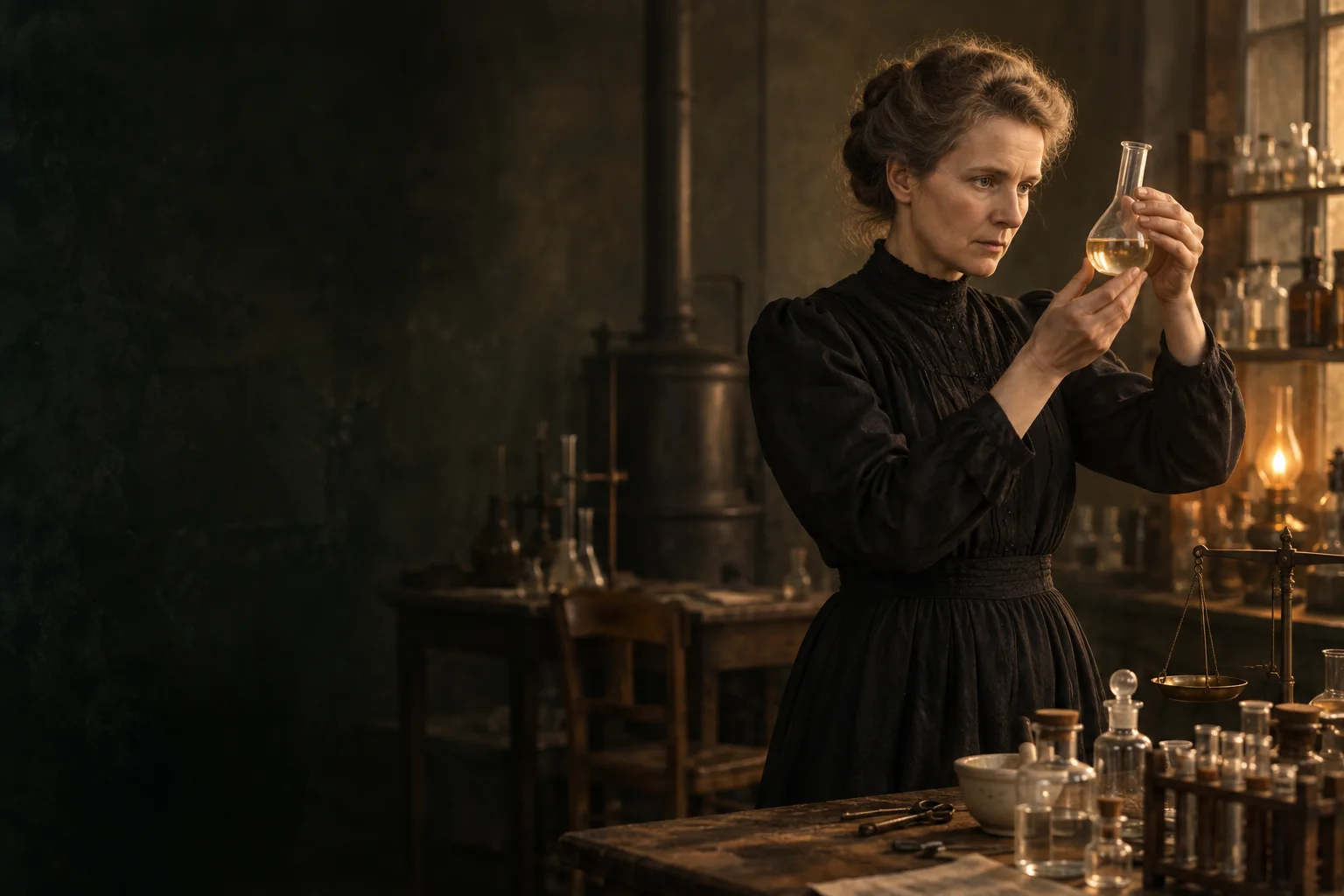
Read the storyEditorial illustration · not a historical source
A question can change a life.
Mission 6 · 6–12 minutes
Start the case
No account needed. Your work is saved in this browser; sign in any time to keep it in your account.
The First World War took Marie Curie’s scientific work beyond the laboratory. In 1914, she began organising mobile X-ray units for wounded soldiers. Equipment could travel to places where doctors needed to locate injuries. The vehicles became known as petites Curies, or little Curies. These machines used X-rays. Curie’s discoveries of polonium and radium belonged to another strand of the history of radiation. The difference matters: calling every form of radiation “radium” would conceal what the wartime vehicles actually did. The American Institute of Physics describes their X-ray equipment and Curie’s work organising it. Her daughter Irène helped with the wartime work. By 1916, Curie had also begun training women as radiological assistants. Scientific knowledge had to be combined with equipment, transport and training. The story did not end when a medal was awarded, and it was not carried forward by Marie alone. Her own route had begun much earlier: Warsaw schooling, the move to Paris in 1891 and the later doctorate in 1903. Polonium and radium were announced in 1898. The shared Physics Nobel in 1903 and Chemistry Nobel in 1911 marked recognition at different stages. Her 1911 lecture attributed the discoveries to collaboration with Pierre. A later BnF entry dates the second edition of her thesis to 1904. These dates belong to different kinds of achievement, rather than to one uninterrupted list of triumphs. Marie died on 4 July 1934 at the Sancellemoz sanatorium in France. The recorded diagnosis was aplastic anaemia. Accounts connect her illness with radiation exposure, but differ on the precise explanation. Naming the diagnosis does not establish which exposure caused it. A biography can preserve that limit without hiding the death or turning it into a dramatic scene. In 1995, Marie and Pierre’s remains were moved to the Panthéon in Paris. She became the first woman interred there in recognition of her own achievements. She was not the first woman ever buried there. The distinction is small in words but important to the meaning of the honour. What should remain in a short account of this life? The education, announcements, collaborators, later chemical work, wartime radiography and public remembrance all deserve a place. The familiar claim that Marie discovered radioactivity alone fails against Becquerel’s 1896 discovery. Her contribution included naming the phenomenon in joint work with Pierre, investigating it and discovering new radioactive elements. Her achievement becomes clearer when the surrounding lives and different dates remain visible.
Words and phrases in context
Return to the sources
Sources and limits
Nobel Prize: Marie Curie — Biographical
institutional · Biographical account associated with the 1911 prize; web display date not used as event date.
Nobel Prize: Marie Curie — Biographical (new tab)An institutional retrospective biography. It is not a laboratory notebook.
Musée Curie: La création de la Fondation Curie — chronologie
institutional · Modern chronology; entry for 1898.
Musée Curie: La création de la Fondation Curie — chronologie (new tab)An institutional chronology gives retrospective dates, not individual laboratory measurements. Its 1896 and 1898 entries were rechecked in the indexed full text on 2026-10-03.
BnF catalogue: Recherches sur les substances radioactives, second edition
institutional · 1904 second edition; catalogue record FRBNF30291901.
BnF catalogue: Recherches sur les substances radioactives, second edition (new tab)A catalogue establishes bibliographic metadata. Its second-edition date must not be treated as the date of every experiment or the original thesis defence.
Nobel Prize: Marie Curie — Facts, Physics 1903
institutional · 1903 award; undated current fact page.
Nobel Prize: Marie Curie — Facts, Physics 1903 (new tab)The award record documents recognition; it is not the complete experimental evidence or a measure of one person’s contribution.
Nobel Prize: Marie Curie — Facts, Chemistry 1911
institutional · 1911 award; undated current fact page.
Nobel Prize: Marie Curie — Facts, Chemistry 1911 (new tab)The award record documents later recognition, not every step of the research.
Marie Curie: Nobel Lecture, Radium and the New Concepts in Chemistry
primary · 11 December 1911 lecture.
Marie Curie: Nobel Lecture, Radium and the New Concepts in Chemistry (new tab)A later first-person public account, delivered in 1911. Its account of collaboration is not an 1898 laboratory notebook.
Nobel Prize: Marie and Pierre Curie and the discovery of polonium and radium
institutional · Historical essay by Nanny Fröman, 1 December 1996.
Nobel Prize: Marie and Pierre Curie and the discovery of polonium and radium (new tab)A retrospective essay. Its 1908 chair date and leukemia wording differ from other accounts; neither is silently used here.
American Institute of Physics: Radiology at the Front
institutional · Historical exhibit published 2000; wartime radiography from 1914.
American Institute of Physics: Radiology at the Front (new tab)A later account of mobile X-ray work; it cannot establish the outcome of every treatment.
American Institute of Physics: Physical Decline
institutional · Historical exhibit published 2000; death 1934 and reinterment 1995.
American Institute of Physics: Physical Decline (new tab)Reports the diagnosis and later honour. A diagnosis alone cannot identify a single causal exposure.
Marie Curie — Wikipedia
reference · Current reference article, checked 3 October 2026.
Marie Curie — Wikipedia (new tab)A changing secondary reference; its sources and disagreements need independent review.
American Institute of Physics: The Discovery of Polonium and Radium
institutional · Historical exhibit published 2000; announcements in 1898.
American Institute of Physics: The Discovery of Polonium and Radium (new tab)A later narrative distinguishes chemical fractions and subsequent purification; it is not the original announcement.
American Institute of Physics: X-rays and Uranium Rays
institutional · Historical exhibit published 2000; research from 1896.
American Institute of Physics: X-rays and Uranium Rays (new tab)Explains the experiments retrospectively; it does not supply every original measurement.
American Institute of Physics: A Military Radiotherapy Service
institutional · Historical exhibit published 2000; events 1915–1919.
American Institute of Physics: A Military Radiotherapy Service (new tab)A later account of the training courses; it does not list the women trained or every post they held.