
Whose discovery?
Compare an award record with scientists’ accounts of collaboration.
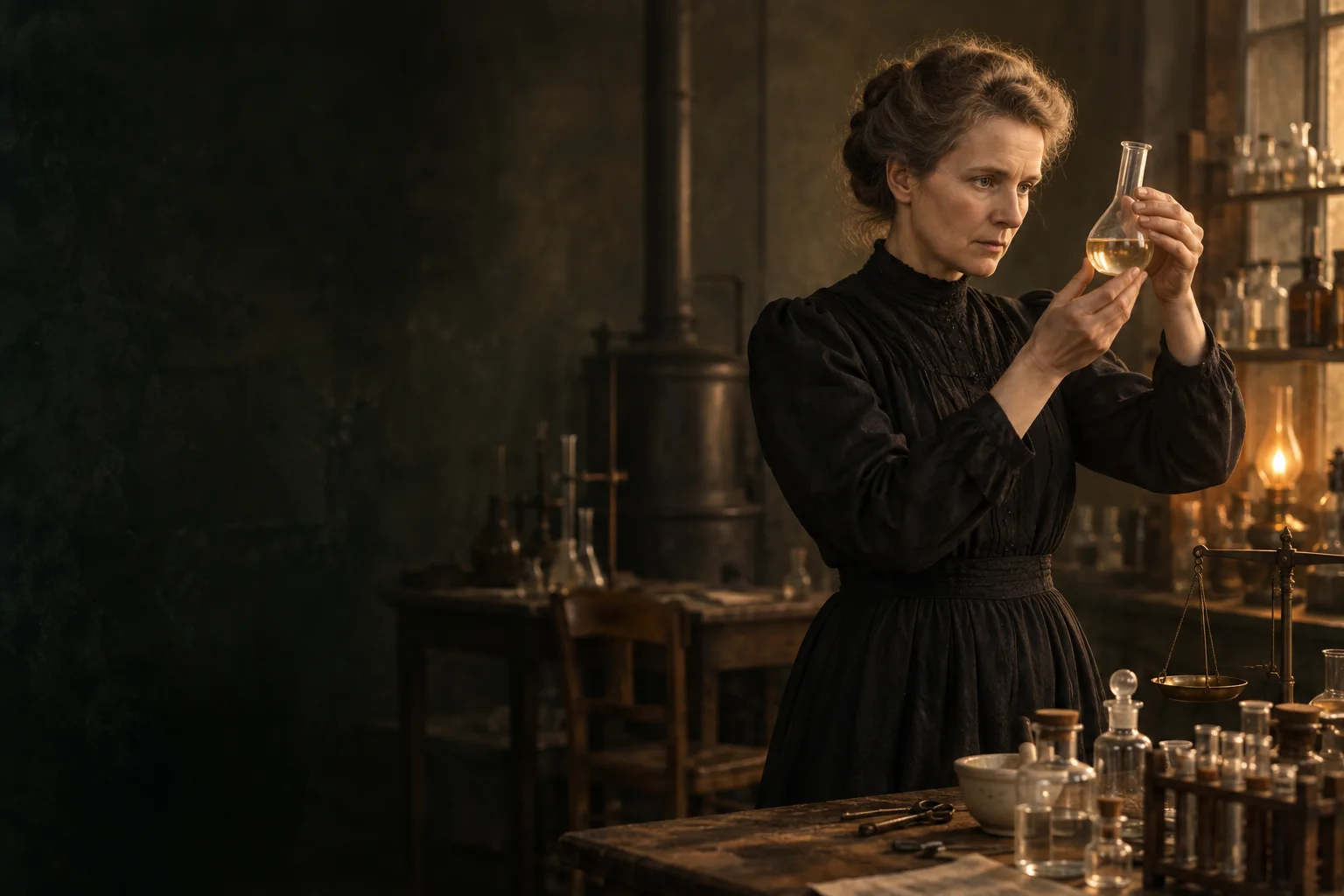
Read the storyEditorial illustration · not a historical source
A question can change a life.
Mission 3 · 6–12 minutes
Start the case
No account needed. Your work is saved in this browser; sign in any time to keep it in your account.
In 1903, a nomination for the Physics Nobel Prize named Henri Becquerel and Pierre Curie but left Marie out. Gösta Mittag-Leffler, a Swedish mathematician, alerted Pierre. Pierre’s surviving reply asked that Marie be considered with him. The research had been shared; the initial nomination did not name everyone who had shared it. The final award went to Becquerel, Pierre Curie and Marie Curie. The two prize citations distinguish Becquerel’s discovery of spontaneous radioactivity from the Curies’ joint research on that radiation. Those words preserve different kinds of work. They do not say that Becquerel discovered polonium or that Pierre worked alone. Marie had begun investigating uranium rays before Pierre joined her search for new radioactive elements. In July 1898, they announced polonium together. The December paper announcing radium carried a third name, Gustave Bémont. Pierre’s later Nobel lecture also names Bémont in the radium work. A short description that lists only the two Curies can therefore miss another contributor to a particular announcement. Their shared life and shared science did not begin on the same date. Marie met Pierre in 1894, and they married on 26 July 1895 in Sceaux. Those dates help place their collaboration, but marriage itself does not establish who performed each experiment. The names on papers and the accounts of the research answer a different question from a marriage record. On 11 December 1911, Marie gave her Chemistry Nobel lecture. She attributed the discoveries of polonium and radium to work with Pierre. She described the chemical work of isolating pure radium salt as her own, while stressing that it was closely bound to their common work. This was her own later public account, rather than a notebook written during the discoveries. The Nobel historical essay describes the omitted nomination and Pierre’s reply. The 1903 award record identifies the final recipients. Marie’s 1911 lecture explains how she described the work afterwards. These sources agree that the research involved Marie and Pierre, while answering different questions about recognition and contribution. Who belongs in the account of these discoveries? Becquerel’s earlier finding, Marie’s investigation, Pierre’s collaboration and Bémont’s name on the radium paper all matter. The omission in the nomination is the twist: a prize list is the result of decisions about recognition, and cannot by itself show how the work was done.
Words and phrases in context
Return to the sources
Sources and limits
Musée Curie: La création de la Fondation Curie — chronologie
institutional · Modern chronology; entry for 1898.
Musée Curie: La création de la Fondation Curie — chronologie (new tab)An institutional chronology gives retrospective dates, not individual laboratory measurements. Its 1896 and 1898 entries were rechecked in the indexed full text on 2026-10-03.
Nobel Prize: Marie Curie — Facts, Physics 1903
institutional · 1903 award; undated current fact page.
Nobel Prize: Marie Curie — Facts, Physics 1903 (new tab)The award record documents recognition; it is not the complete experimental evidence or a measure of one person’s contribution.
Marie Curie: Nobel Lecture, Radium and the New Concepts in Chemistry
primary · 11 December 1911 lecture.
Marie Curie: Nobel Lecture, Radium and the New Concepts in Chemistry (new tab)A later first-person public account, delivered in 1911. Its account of collaboration is not an 1898 laboratory notebook.
Nobel Prize: Marie and Pierre Curie and the discovery of polonium and radium
institutional · Historical essay by Nanny Fröman, 1 December 1996.
Nobel Prize: Marie and Pierre Curie and the discovery of polonium and radium (new tab)A retrospective essay. Its 1908 chair date and leukemia wording differ from other accounts; neither is silently used here.
Pierre Curie: Nobel Lecture
primary · 1905 lecture associated with the 1903 Physics prize.
Pierre Curie: Nobel Lecture (new tab)A later first-person account names Bémont but does not allocate every hour of laboratory work.
Marie Curie — Wikipedia
reference · Current reference article, checked 3 October 2026.
Marie Curie — Wikipedia (new tab)A changing secondary reference; its sources and disagreements need independent review.
American Institute of Physics: The Discovery of Polonium and Radium
institutional · Historical exhibit published 2000; announcements in 1898.
American Institute of Physics: The Discovery of Polonium and Radium (new tab)A later narrative distinguishes chemical fractions and subsequent purification; it is not the original announcement.