
Strange rays
Distinguish Becquerel’s discovery, the Curie announcements and the later prizes.
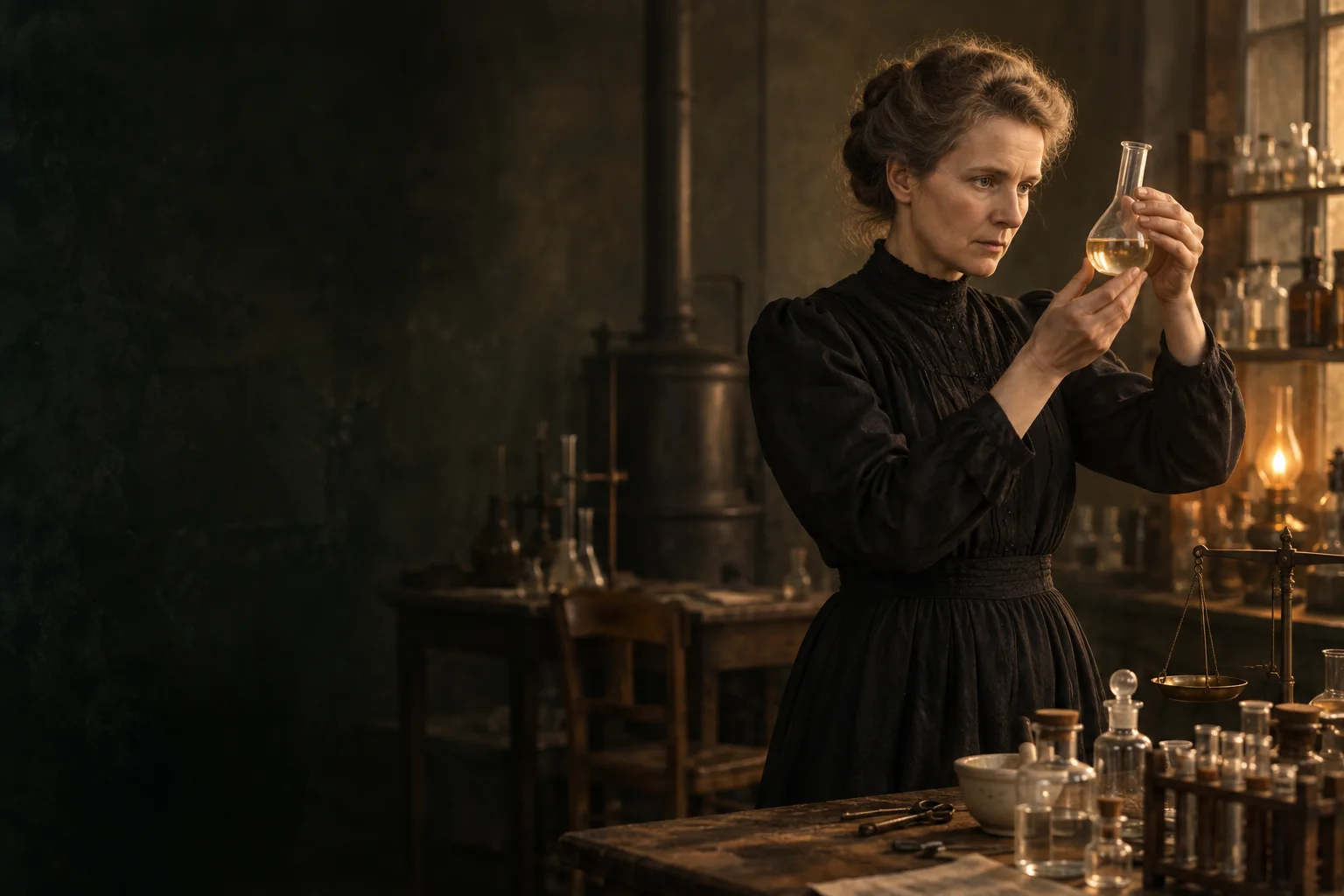
Read the storyEditorial illustration · not a historical source
A question can change a life.
Mission 2 · 6–12 minutes
Start the case
No account needed. Your work is saved in this browser; sign in any time to keep it in your account.
A uranium mineral gave Marie Curie an unexpected result: its radiation was stronger than the uranium inside it could explain. If the measurement was right, the mineral contained something else. A substance already known to science could be hiding one that was still unknown. The question began with Henri Becquerel. In 1896 he found that uranium salts gave off penetrating rays without needing sunlight to set them off. Marie chose uranium rays as a subject for research. She used an electrometer that Pierre and his brother Jacques had built years earlier. An electrometer is an instrument that detects very small electrical charges or currents; it turned an invisible effect into something she could compare between samples. She found that the strength of the radiation from uranium compounds depended on the amount of uranium. She proposed that this property belonged to the atom itself. But pitchblende, a uranium ore, was more active than pure uranium. Its extra activity did not fit an explanation based on uranium alone. Pierre Curie joined the investigation, setting aside his work on crystals. The Curies separated the ore into different chemical fractions and measured their activity. Strong radiation followed material associated with bismuth and with barium. In July 1898, Marie and Pierre announced an element they called polonium, after Marie’s native Poland. On 26 December 1898, Marie Curie, Pierre Curie and Gustave Bémont announced radium. These were separate announcements, though both belonged to the same year. Finding evidence for a new element did not instantly produce a pure sample. The substances were present in small amounts, mixed with other material. Further separation and measurement were needed. Marie introduced the word radioactivity in their joint work. Naming the phenomenon was one contribution; Becquerel’s earlier discovery and the search for additional elements were other contributions. Musée Curie’s chronology places Becquerel’s uranium rays in 1896 and the two Curie discoveries in 1898. The American Institute of Physics explains the measurements and chemical separations. Later came a shared Physics Nobel Prize in 1903 and Marie’s Chemistry Nobel Prize in 1911. A prize date therefore cannot replace a discovery date. The twist was inside the ore: the strongest activity pointed beyond the element they had set out to study. What sequence connects that measurement with the two announcements? Keeping July and December distinct shows how the investigation developed without pretending that every step happened at once.
Words and phrases in context
Return to the sources
Sources and limits
Nobel Prize: Marie Curie — Biographical
institutional · Biographical account associated with the 1911 prize; web display date not used as event date.
Nobel Prize: Marie Curie — Biographical (new tab)An institutional retrospective biography. It is not a laboratory notebook.
Musée Curie: La création de la Fondation Curie — chronologie
institutional · Modern chronology; entry for 1898.
Musée Curie: La création de la Fondation Curie — chronologie (new tab)An institutional chronology gives retrospective dates, not individual laboratory measurements. Its 1896 and 1898 entries were rechecked in the indexed full text on 2026-10-03.
Nobel Prize: Marie Curie — Facts, Physics 1903
institutional · 1903 award; undated current fact page.
Nobel Prize: Marie Curie — Facts, Physics 1903 (new tab)The award record documents recognition; it is not the complete experimental evidence or a measure of one person’s contribution.
Nobel Prize: Marie Curie — Facts, Chemistry 1911
institutional · 1911 award; undated current fact page.
Nobel Prize: Marie Curie — Facts, Chemistry 1911 (new tab)The award record documents later recognition, not every step of the research.
American Institute of Physics: X-rays and Uranium Rays
institutional · Historical exhibit published 2000; research from 1896.
American Institute of Physics: X-rays and Uranium Rays (new tab)Explains the experiments retrospectively; it does not supply every original measurement.
American Institute of Physics: The Discovery of Polonium and Radium
institutional · Historical exhibit published 2000; announcements in 1898.
American Institute of Physics: The Discovery of Polonium and Radium (new tab)A later narrative distinguishes chemical fractions and subsequent purification; it is not the original announcement.
Pierre Curie: Nobel Lecture
primary · 1905 lecture associated with the 1903 Physics prize.
Pierre Curie: Nobel Lecture (new tab)A later first-person account names Bémont but does not allocate every hour of laboratory work.
Marie Curie — Wikipedia
reference · Current reference article, checked 3 October 2026.
Marie Curie — Wikipedia (new tab)A changing secondary reference; its sources and disagreements need independent review.
Nobel Prize: Marie and Pierre Curie and the discovery of polonium and radium
institutional · Historical essay by Nanny Fröman, 1 December 1996.
Nobel Prize: Marie and Pierre Curie and the discovery of polonium and radium (new tab)A retrospective essay. Its 1908 chair date and leukemia wording differ from other accounts; neither is silently used here.