
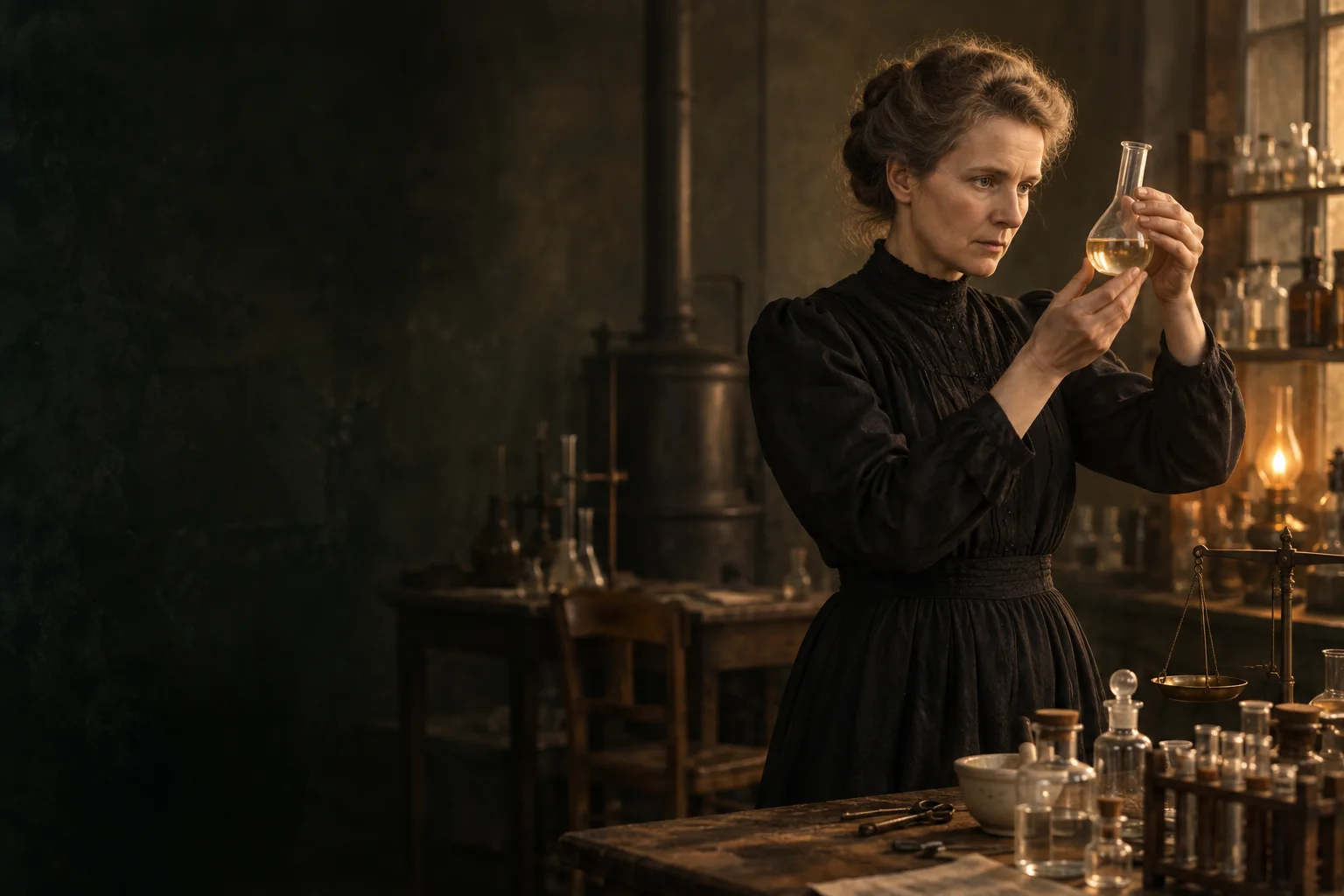
A student in Warsaw
Explain how the rules and opportunities of Warsaw shaped Maria Skłodowska’s route to Paris.
Read the storyEditorial illustration · not a historical source
A question can change a life.
Mission 1 · 6–12 minutes
Start the case
No account needed. Your work is saved in this browser; sign in any time to keep it in your account.
In Warsaw, a gold medal at school did not open every door. Maria Salomea Skłodowska graduated from secondary school in 1883, but the city’s university did not admit women. The future Marie Curie had to find another way to continue studying science. She had been born in Warsaw on 7 November 1867. The city belonged to Congress Poland, within the Russian Empire. Her parents were teachers, and her father taught mathematics and physics. Laboratory lessons had been banned from Polish schools, so he kept his teaching apparatus at home and used it with his children. Science was already part of Maria’s education before Paris entered the story. Maria and her sister Bronisława attended the clandestine Flying University, which accepted women. It moved from place to place so that the authorities could not find it. This was higher study organised outside the ordinary university system. The name describes how the classes moved, rather than a journey abroad. The sisters also made a practical agreement. Maria would help pay for Bronisława’s medical studies in Paris; Bronisława would later help Maria study there. Maria worked as a tutor and then as a governess for the Żorawski family in Szczuki. She continued studying while earning money. These jobs belong to the route towards her scientific career, even though they were not university posts. In late 1891, Maria left for France and enrolled at the University of Paris. There she used the name Marie. She earned a physics degree in 1893 and a mathematics degree in 1894. A place at university had become possible, but it followed years of study and paid work. The change of country mattered because the opportunities available to a woman were different. The American Institute of Physics accounts of her girlhood and governess years trace these educational barriers and the sisters’ arrangement. The Nobel biography confirms her move to Paris and her later doctorate in 1903. BnF catalogues a second edition of her thesis published in Paris in 1904. Those later dates do not turn her Warsaw schooling into doctoral research. They show how far the story would continue after the move. How did a student excluded from the ordinary university in Warsaw reach a university in Paris? Her route connects a secret school, a sister’s studies and paid work. A list of prizes alone would leave that beginning out.
Words and phrases in context
Return to the sources
Sources and limits
Nobel Prize: Marie Curie — Biographical
institutional · Biographical account associated with the 1911 prize; web display date not used as event date.
Nobel Prize: Marie Curie — Biographical (new tab)An institutional retrospective biography. It is not a laboratory notebook.
BnF catalogue: Recherches sur les substances radioactives, second edition
institutional · 1904 second edition; catalogue record FRBNF30291901.
BnF catalogue: Recherches sur les substances radioactives, second edition (new tab)A catalogue establishes bibliographic metadata. Its second-edition date must not be treated as the date of every experiment or the original thesis defence.
American Institute of Physics: Polish Girlhood
institutional · Historical exhibit published 2000; events 1867–1891.
American Institute of Physics: Polish Girlhood (new tab)A later historical account; it does not record every lesson or private conversation.
American Institute of Physics: A Student in Paris
institutional · Historical exhibit published 2000; events 1891–1897.
American Institute of Physics: A Student in Paris (new tab)A retrospective account of study and marriage, not a complete university register.
Marie Curie — Wikipedia
reference · Current reference article, checked 3 October 2026.
Marie Curie — Wikipedia (new tab)A changing secondary reference; its sources and disagreements need independent review.
American Institute of Physics: The Governess
institutional · Historical exhibit published 2000; events 1884–1891.
American Institute of Physics: The Governess (new tab)A later historical account of the sisters’ pact and the governess years; it gives no complete record of the payments between the sisters.