
From ore to element
Separate measurements, scientific explanation, a doctorate and a later edition date.
Read the storyEditorial illustration · not a historical source
A question can change a life.
Mission 4 · 6–12 minutes
Start the case
No account needed. Your work is saved in this browser; sign in any time to keep it in your account.
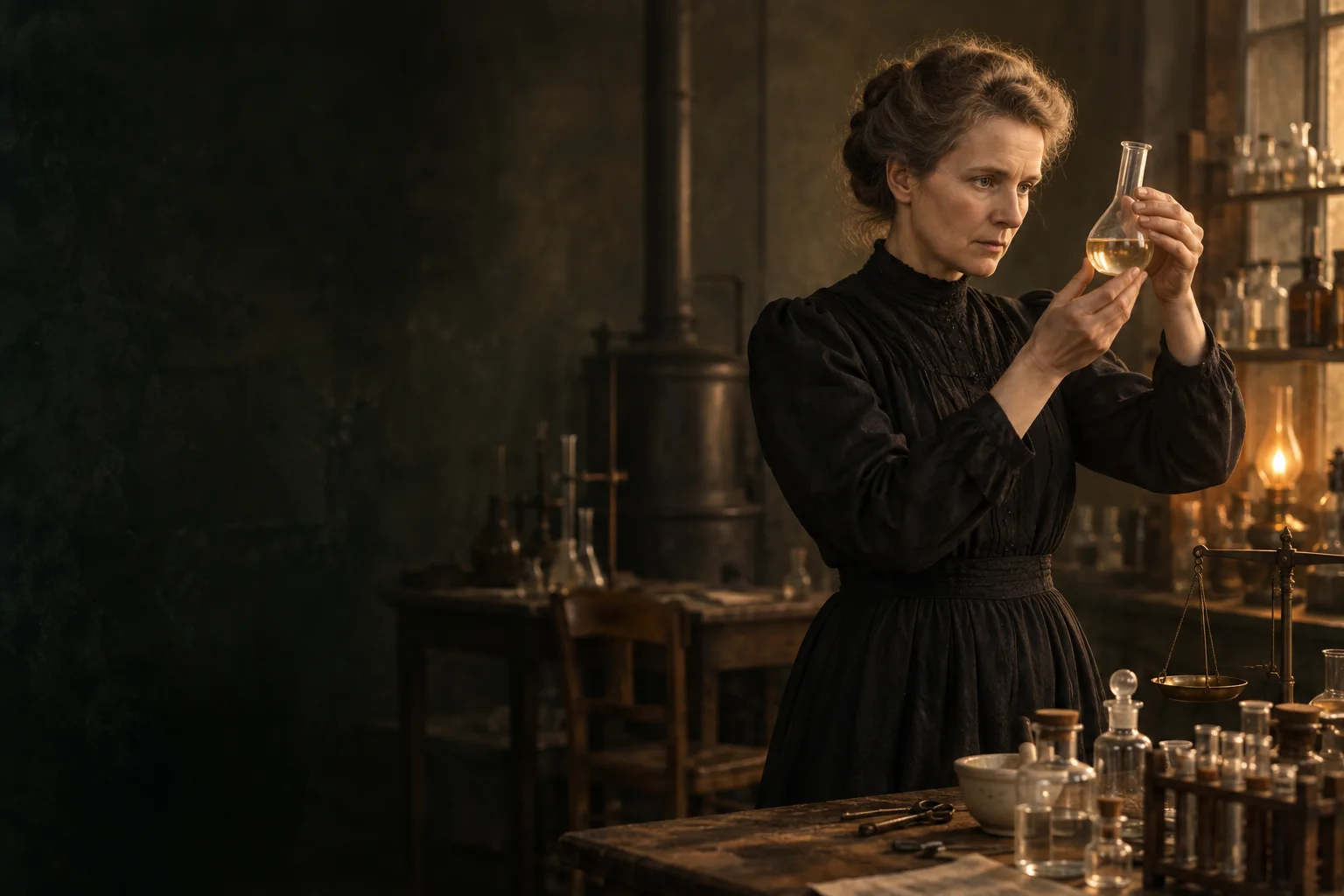
The announcement of radium in 1898 left a difficult problem. The Curies could detect strong radiation in the ore, but the material producing it was mixed with other substances. A name for the element did not make a pure sample appear. The years after the announcement belong to the discovery story too. Radium was chemically close to barium, which was also present in pitchblende. Marie Curie had to separate material whose chemical behaviour was similar. Radiation measurements helped follow the active substance through repeated separations. The American Institute of Physics account describes how chemical work and electrical measurements were used together, rather than as competing ways of finding an answer. By 1902, Marie Curie had separated about a tenth of a gram of radium chloride. A radium salt is a compound containing radium; it is not the same thing as pure radium metal. Establishing the element involved examining its properties and measuring its atomic weight. This work followed the earlier inference that the ore’s extra radiation pointed to an unknown substance. In June 1903, Marie received her doctorate from the University of Paris. Her thesis was titled Recherches sur les substances radioactives, or Research on Radioactive Substances. The degree recognised research already carried out. It did not mean that the original radium announcement happened in 1903. BnF’s catalogue describes a second edition of that thesis published in Paris in 1904. The words “second edition” matter. They identify a later publication, rather than a first experiment or a second doctorate. A catalogue can establish the author, title, edition and publication date while leaving the details of a particular laboratory session unanswered. Marie’s Nobel lecture in 1911 looked back at the discoveries and described her chemical work as her own while calling it intimately connected with their common work with Pierre. She explained how preparing radium salts and measuring radium’s atomic weight helped establish it as a new element. By 1910 she and André Debierne had also prepared radium metal. Announcement, salt, metal, doctorate and book edition were connected, but they were not interchangeable events. How did the case for a new element become stronger? The answer rests on a sequence of measurements and separations, then on records describing distinct achievements. The apparent contradiction between a 1903 doctorate and a 1904 thesis edition disappears when the publication is read carefully: the catalogue dates an edition, while the biography dates the degree.
Words and phrases in context
Return to the sources
Sources and limits
Marie Curie: Nobel Lecture, Radium and the New Concepts in Chemistry
primary · 11 December 1911 lecture.
Marie Curie: Nobel Lecture, Radium and the New Concepts in Chemistry (new tab)A later first-person public account, delivered in 1911. Its account of collaboration is not an 1898 laboratory notebook.
BnF catalogue: Recherches sur les substances radioactives, second edition
institutional · 1904 second edition; catalogue record FRBNF30291901.
BnF catalogue: Recherches sur les substances radioactives, second edition (new tab)A catalogue establishes bibliographic metadata. Its second-edition date must not be treated as the date of every experiment or the original thesis defence.
Nobel Prize: Marie Curie — Facts, Physics 1903
institutional · 1903 award; undated current fact page.
Nobel Prize: Marie Curie — Facts, Physics 1903 (new tab)The award record documents recognition; it is not the complete experimental evidence or a measure of one person’s contribution.
Nobel Prize: Marie Curie — Biographical
institutional · Biographical account associated with the 1911 prize; web display date not used as event date.
Nobel Prize: Marie Curie — Biographical (new tab)An institutional retrospective biography. It is not a laboratory notebook.
American Institute of Physics: The Discovery of Polonium and Radium
institutional · Historical exhibit published 2000; announcements in 1898.
American Institute of Physics: The Discovery of Polonium and Radium (new tab)A later narrative distinguishes chemical fractions and subsequent purification; it is not the original announcement.
American Institute of Physics: Honors from Abroad
institutional · Historical exhibit published 2000; June 1903 thesis defence.
American Institute of Physics: Honors from Abroad (new tab)A retrospective description of the doctorate; no defence transcript is reproduced.
Nobel Prize: Marie and Pierre Curie and the discovery of polonium and radium
institutional · Historical essay by Nanny Fröman, 1 December 1996.
Nobel Prize: Marie and Pierre Curie and the discovery of polonium and radium (new tab)A retrospective essay. Its 1908 chair date and leukemia wording differ from other accounts; neither is silently used here.
Pierre Curie: Nobel Lecture
primary · 1905 lecture associated with the 1903 Physics prize.
Pierre Curie: Nobel Lecture (new tab)A later first-person account names Bémont but does not allocate every hour of laboratory work.
Marie Curie — Wikipedia
reference · Current reference article, checked 3 October 2026.
Marie Curie — Wikipedia (new tab)A changing secondary reference; its sources and disagreements need independent review.