
Prizes, a lost election and no patent
Explain why discovery, academic appointment and public recognition have different dates.
Read the storyEditorial illustration · not a historical source
A question can change a life.
Mission 5 · 6–12 minutes
Start the case
No account needed. Your work is saved in this browser; sign in any time to keep it in your account.
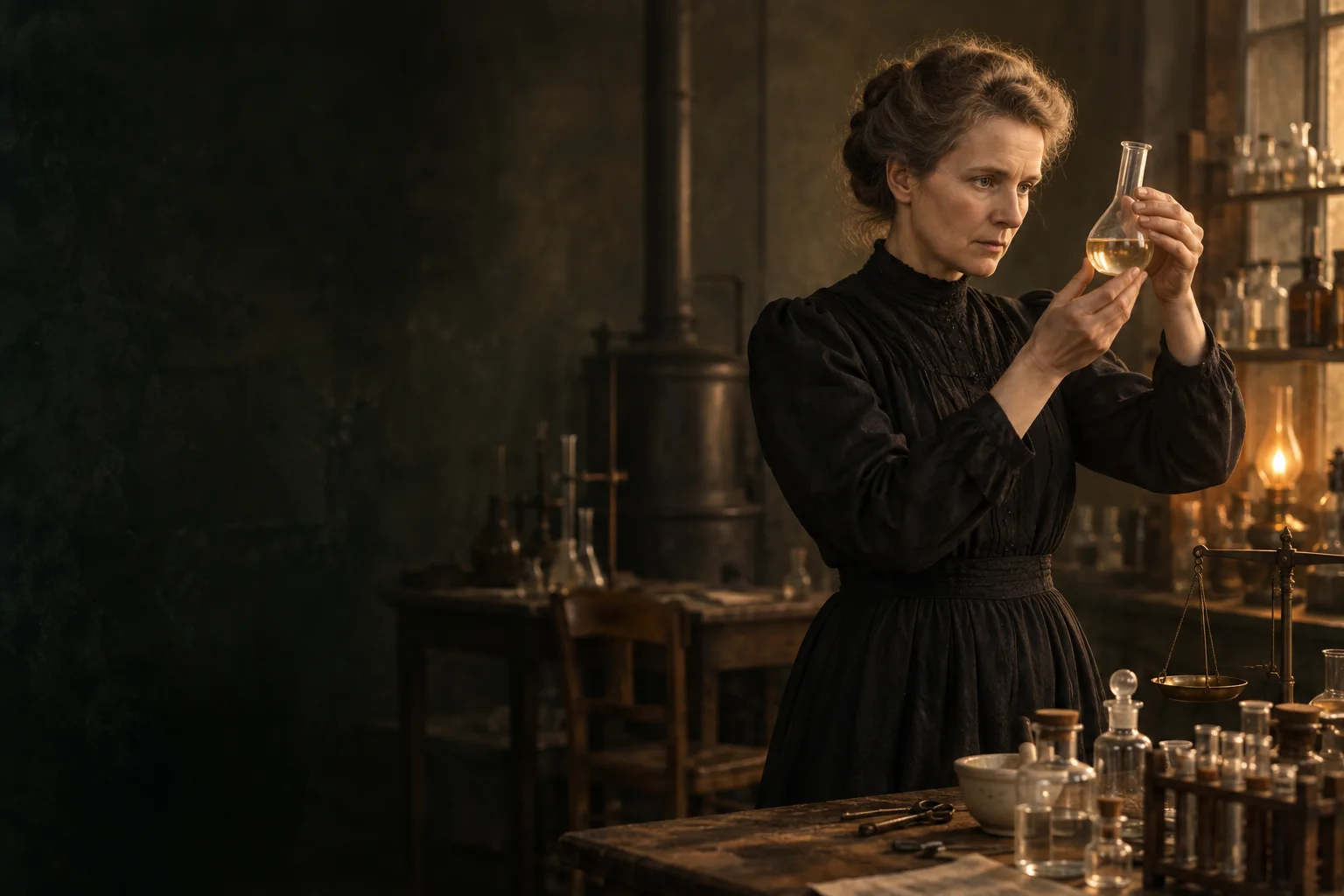
Marie Curie won the Chemistry Nobel Prize in 1911, the same year she failed to gain a seat in the French Academy of Sciences. International honour and rejection at home could belong to one year. Neither event changed the date on which polonium and radium had been announced. Her work had continued through a major loss. Pierre died in a street accident in Paris on 19 April 1906. The University of Paris offered Marie the teaching position associated with his chair, and she took up his work there. Several accounts call her its first woman professor. Accounts distinguish her teaching in his place in 1906 from her later formal appointment to the full chair. The important point is that her university work continued after his death. In 1910, Marie and André Debierne prepared radium in metallic form. That was another stage of the chemical work. The Curies had announced radium in December 1898; a later pure-metal preparation did not erase that announcement. The discovery year, a later laboratory achievement and an award year answer different questions. On 23 January 1911, Édouard Branly won the place; Curie lost by one vote on the first ballot and by two on the second. The American Institute of Physics describes hostile coverage directed at Marie’s foreign background during the election. Such coverage is evidence about the contest for recognition, rather than evidence against the existence of radium. The Nobel Chemistry citation recognised the discoveries of polonium and radium, the isolation of radium, and study of its nature and compounds. The earlier Physics prize in 1903 had recognised Becquerel’s discovery and the Curies’ research on radiation. Reading the citations separately shows that the awards did not simply record identical events on different dates. The Curies also published their methods for isolating radium without taking out patents. The American Institute of Physics describes this publication and the developing radium industry. They did not gain the commercial fortune a successful patent might suggest. An unpatented process could circulate, while laboratories still needed equipment, material and money. What kind of recognition followed the work? Teaching, membership elections, prizes and commercial reward were separate paths. The lost election is a useful twist in a story usually told through medals. A map reconstructed for 1900 can place the earlier discoveries in their political setting, but cannot tell us how any Academy member voted in 1911 or how the Nobel committee decided.
Words and phrases in context
Return to the sources
Sources and limits
Musée Curie: La création de la Fondation Curie — chronologie
institutional · Modern chronology; entry for 1898.
Musée Curie: La création de la Fondation Curie — chronologie (new tab)An institutional chronology gives retrospective dates, not individual laboratory measurements. Its 1896 and 1898 entries were rechecked in the indexed full text on 2026-10-03.
Nobel Prize: Marie Curie — Facts, Physics 1903
institutional · 1903 award; undated current fact page.
Nobel Prize: Marie Curie — Facts, Physics 1903 (new tab)The award record documents recognition; it is not the complete experimental evidence or a measure of one person’s contribution.
Nobel Prize: Marie Curie — Facts, Chemistry 1911
institutional · 1911 award; undated current fact page.
Nobel Prize: Marie Curie — Facts, Chemistry 1911 (new tab)The award record documents later recognition, not every step of the research.
Nobel Prize: Marie Curie — Biographical
institutional · Biographical account associated with the 1911 prize; web display date not used as event date.
Nobel Prize: Marie Curie — Biographical (new tab)An institutional retrospective biography. It is not a laboratory notebook.
Nobel Prize: Marie and Pierre Curie and the discovery of polonium and radium
institutional · Historical essay by Nanny Fröman, 1 December 1996.
Nobel Prize: Marie and Pierre Curie and the discovery of polonium and radium (new tab)A retrospective essay. Its 1908 chair date and leukemia wording differ from other accounts; neither is silently used here.
American Institute of Physics: Founding the Radium Industry
institutional · Historical exhibit published 2000; early twentieth-century industry.
American Institute of Physics: Founding the Radium Industry (new tab)Documents publication without patents, but is not a complete financial account of the Curies.
American Institute of Physics: The Academy Debacle
institutional · Historical exhibit published 2000; election 23 January 1911.
American Institute of Physics: The Academy Debacle (new tab)AIP gives the final two-vote margin; the Nobel essay adds a one-vote first ballot.
Pierre Curie: Nobel Lecture
primary · 1905 lecture associated with the 1903 Physics prize.
Pierre Curie: Nobel Lecture (new tab)A later first-person account names Bémont but does not allocate every hour of laboratory work.
Marie Curie — Wikipedia
reference · Current reference article, checked 3 October 2026.
Marie Curie — Wikipedia (new tab)A changing secondary reference; its sources and disagreements need independent review.
American Institute of Physics: The Discovery of Polonium and Radium
institutional · Historical exhibit published 2000; announcements in 1898.
American Institute of Physics: The Discovery of Polonium and Radium (new tab)A later narrative distinguishes chemical fractions and subsequent purification; it is not the original announcement.
Marie Curie: Nobel Lecture, Radium and the New Concepts in Chemistry
primary · 11 December 1911 lecture.
Marie Curie: Nobel Lecture, Radium and the New Concepts in Chemistry (new tab)A later first-person public account, delivered in 1911. Its account of collaboration is not an 1898 laboratory notebook.