
The trunk and the train
Follow a supported movement while distinguishing testimony from a map reconstruction.
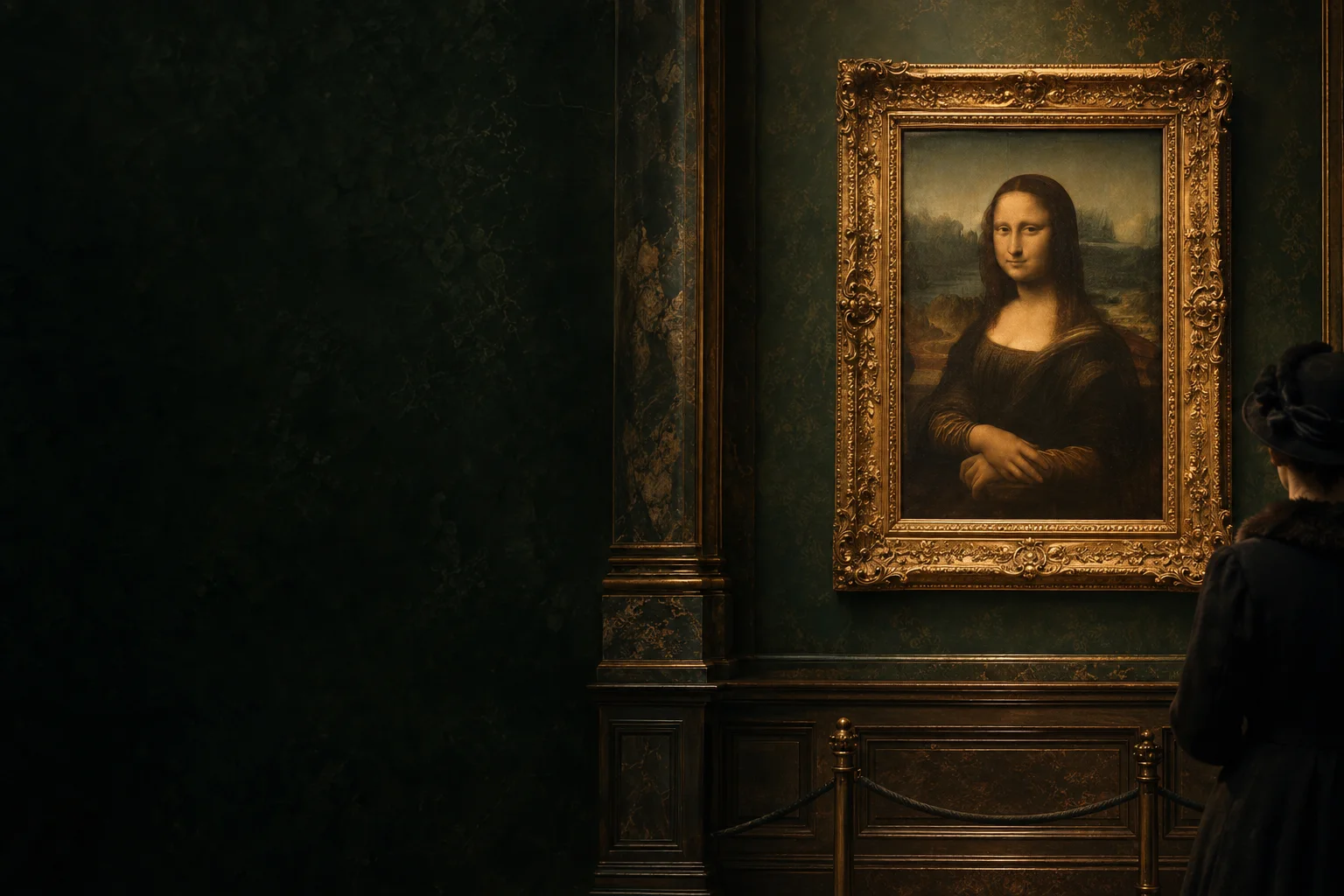
Read the storyEditorial illustration · not a historical source
Follow the evidence, beyond the frame.
Mission 4 · 6–12 minutes
Start the case
No account needed. Your work is saved in this browser; sign in any time to keep it in your account.
Vincenzo Peruggia had moved to Paris in 1908. Born in Dumenza in Italy on 8 October 1881, he later found work at the Louvre cleaning paintings, refitting frames and helping to make protective cases. His connection to the painting began as work around it. By 1911, it had become a theft: he hid the Mona Lisa in his Paris apartment. After about two years, he carried the painting to Italy by train. The account gives that means of travel, but it does not give a complete list of trains, stations or stops. Paris and Florence are important places in the story. Connecting them on a map can help show where the case moved; the connecting line would still be a reconstruction, not a trace recorded by the painting. In 1913, Peruggia contacted the Florence art dealer Alfredo Geri. He used the name Leonardo V. A borrowed name did not turn him into Leonardo da Vinci, the painter of the Mona Lisa. Geri brought in Giovanni Poggi, the director of the Uffizi, who authenticated the work. The painting had reached people able to recognise it rather than a buyer who would simply accept the story attached to it. Geri and Poggi placed the painting in safekeeping and informed the police. Peruggia was arrested at his hotel on 12 December 1913. That ending is supported even though the accounts of Geri and Peruggia differ about their dealings. It is not necessary to settle every word of the negotiation to establish that the painting was identified and the police were called. The move had changed the case. In Paris, the painting could remain hidden in an apartment. In Florence, showing the painting to a dealer exposed it to examination. We know these actions because later accounts describe them; a map alone could not tell us that a trunk contained the Mona Lisa or that a dealer contacted a museum director. Looking at a view of 1911 can place the earlier theft in its geographical setting. It does not show the later journey as it happened. The account and the map answer different questions. One describes a person, an object and an arrest; the other helps us see places. The supported trail ends with identification in Florence, without needing an invented stop along the way.
Words and phrases in context
Return to the sources
Sources and limits
Wikipedia: Vincenzo Peruggia
reference · Modern reference article; checked 2026-10-03
Wikipedia: Vincenzo Peruggia (new tab)A revisable reference synthesis, not a contemporary witness statement. Conflicting details are logged in the case research file.
Wikipedia: Mona Lisa
reference · Modern reference article; checked 2026-10-03
Wikipedia: Mona Lisa (new tab)A revisable reference synthesis, not a contemporary witness statement. Conflicting details are logged in the case research file.
Archivio di Stato di Firenze: I tentativi di vendita del dipinto
institutional · Modern exhibition page; documents dated 5 October/25 November 1913 and 2 April 1914.
Archivio di Stato di Firenze: I tentativi di vendita del dipinto (new tab)Exhibition summaries refer to interrogation records and letters. Reported motives remain attributed claims, not independent proof. Scans are not reproduced. Not cited by the current English or French text; the story uses the specified Wikipedia sections.
Louvre: Salle des États — The theft of the century
institutional · Web publication date not stated; describes 21 August 1911 and a later recovery.
Louvre: Salle des États — The theft of the century (new tab)A modern institutional account; not an eyewitness record. Publication and rights review remain pending. Not cited by the current English or French text; the story uses the specified Wikipedia sections.