
Two years of silence
Put dated turning points in order without inventing events inside a long gap.
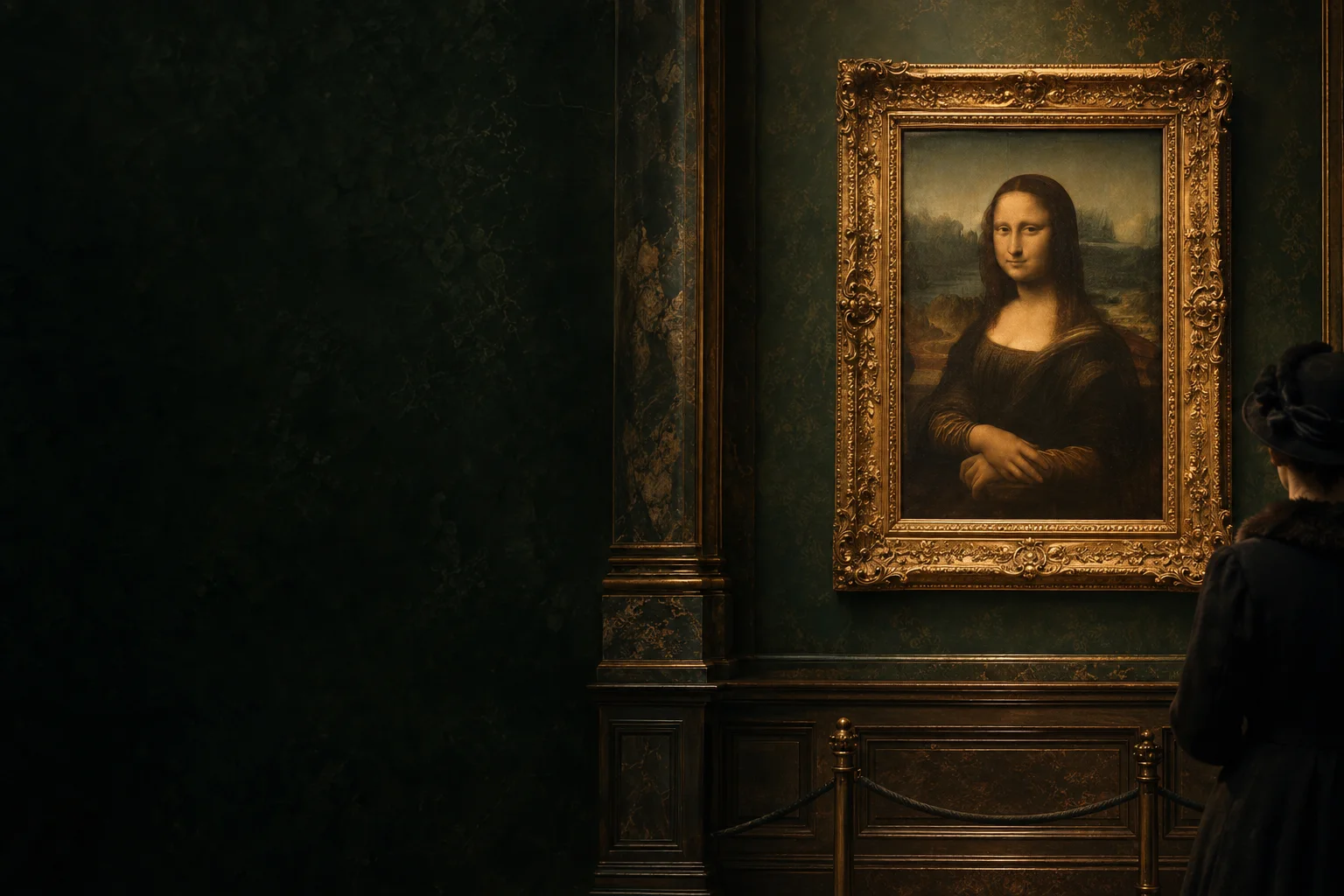
Read the storyEditorial illustration · not a historical source
Follow the evidence, beyond the frame.
Mission 3 · 6–12 minutes
Start the case
No account needed. Your work is saved in this browser; sign in any time to keep it in your account.
The Mona Lisa was taken on 21 August 1911. It was back at the Louvre on 4 January 1914. Those two dates frame a gap of more than two years. Knowing the beginning and ending does not mean knowing every day between them. The painting did not need to travel across the world to remain missing from the museum. Vincenzo Peruggia kept it hidden in his Paris apartment for about two years. One account describes a trunk; another places it under a table during a police visit. The same man who had worked around protective cases at the Louvre now had the missing painting in his own home. This is the twist: the investigation could reach a person without reaching the object he had taken. In September 1911, police called at Peruggia's apartment and spoke to him on two occasions. They did not treat him as a main suspect. His thumbprint had been left on the glass that protected the painting, but the comparison with his police records was not made. These details describe missed chances in the investigation. They do not let us invent a successful search or say that the police had already recovered the painting. The order matters. Questioning Peruggia happened during the early investigation, not after the painting's return. His arrest came much later, on 12 December 1913 in Florence. The recovery there finally broke the long interval. Before it went back to the Louvre, the Mona Lisa was shown at the Uffizi. Its return to the Louvre on 4 January followed the arrest, rather than happening on the same day. Some dates are exact and others are broad. We can place the theft on a named August day and the arrest on a named December day. We can also say the painting was hidden for about two years. That broad length does not reveal every moment when Peruggia moved it, checked it or considered what to do. An account of the case should leave those missing moments missing. The long silence can make a complicated journey sound tempting. Yet the known hiding place is an apartment in Paris. He also later spoke of a trip to London to look for a buyer, but the accounts used here do not trace the painting's movements day by day. The next turning point needs only a move to Italy and contact with someone able to recognise the painting. A timeline makes the interval visible; it cannot turn the interval into a chain of unrecorded adventures.
Words and phrases in context
Return to the sources
Sources and limits
Wikipedia: Mona Lisa
reference · Modern reference article; checked 2026-10-03
Wikipedia: Mona Lisa (new tab)A revisable reference synthesis, not a contemporary witness statement. Conflicting details are logged in the case research file.
Wikipedia: Vincenzo Peruggia
reference · Modern reference article; checked 2026-10-03
Wikipedia: Vincenzo Peruggia (new tab)A revisable reference synthesis, not a contemporary witness statement. Conflicting details are logged in the case research file.
Archivio di Stato di Firenze: I tentativi di vendita del dipinto
institutional · Modern exhibition page; documents dated 5 October/25 November 1913 and 2 April 1914.
Archivio di Stato di Firenze: I tentativi di vendita del dipinto (new tab)Exhibition summaries refer to interrogation records and letters. Reported motives remain attributed claims, not independent proof. Scans are not reproduced. Not cited by the current English or French text; the story uses the specified Wikipedia sections.