
Why did he do it?
Compare an attributed motive with actions and consequences without claiming access to a person’s mind.
Read the storyEditorial illustration · not a historical source
Follow the evidence, beyond the frame.
Mission 6 · 6–12 minutes
Start the case
No account needed. Your work is saved in this browser; sign in any time to keep it in your account.
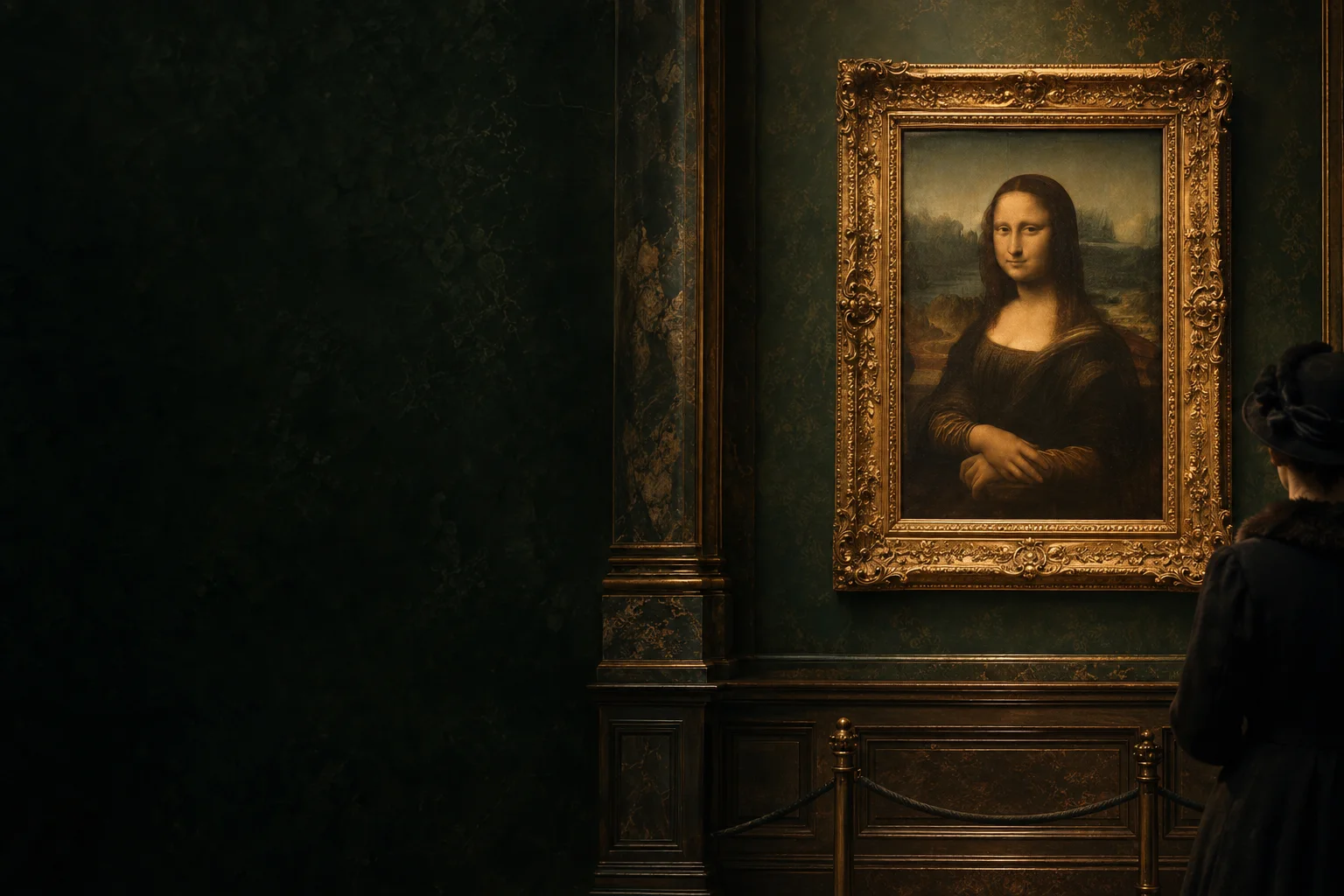
Peruggia said he wanted the Mona Lisa to be shown in Italy. He presented the theft of 21 August 1911 as a patriotic act and said the painting had been taken from Italy by Napoleon. That was mistaken: Leonardo's painting had reached France centuries before Napoleon. A person's explanation of a crime can be part of its history without becoming the final word on why it happened. His actions complicate the explanation. In Florence, he expected a reward for returning the painting. Accounts of his letters also mention money. Wanting the painting in Italy and wanting payment are not identical aims. They may appear in the same person's account, but neither lets us read every private thought behind the theft. The claim about patriotism must stay attached to Peruggia, rather than become an unquestioned description of the crime. The attempt to deal with the painting ended with his arrest on 12 December 1913. He was sentenced to one year and fifteen days in prison, and after appeal he served less than a year. The accounts consulted here disagree on the precise number of months. The safe conclusion is a short prison term following the conviction, not a silently chosen figure from one version. For the painting, the next destination was not permanent hiding. It was exhibited in Italy, including at the Uffizi in Florence, and returned to the Louvre on 4 January 1914. The theft and return drew worldwide attention and helped make the Mona Lisa more widely recognised. Taking it from the wall had changed the way people heard about it, even after the work came back. The case now has an outline that holds together. A theft preceded an empty wall. Apollinaire and Picasso came under suspicion and were cleared. Police questioned Peruggia without finding the hidden painting. A later Florence contact brought Geri, Poggi and the police into the recovery. The return is well established, while an alleged forgery scheme and parts of the thief's motive remain uncertain. There is no need to supply an imagined confession or a single, perfect reason to finish the story. Its ending contains both a recovered painting and questions that stay open. Keeping those questions beside the facts gives a truer account of the case than forcing every part into one tidy explanation.
Words and phrases in context
Return to the sources
Sources and limits
Wikipedia: Vincenzo Peruggia
reference · Modern reference article; checked 2026-10-03
Wikipedia: Vincenzo Peruggia (new tab)A revisable reference synthesis, not a contemporary witness statement. Conflicting details are logged in the case research file.
Wikipedia: Mona Lisa
reference · Modern reference article; checked 2026-10-03
Wikipedia: Mona Lisa (new tab)A revisable reference synthesis, not a contemporary witness statement. Conflicting details are logged in the case research file.
Louvre: Salle des États — The theft of the century
institutional · Web publication date not stated; describes 21 August 1911 and a later recovery.
Louvre: Salle des États — The theft of the century (new tab)A modern institutional account; not an eyewitness record. Publication and rights review remain pending. Not cited by the current English or French text; the story uses the specified Wikipedia sections.
Archivio di Stato di Firenze: I tentativi di vendita del dipinto
institutional · Modern exhibition page; documents dated 5 October/25 November 1913 and 2 April 1914.
Archivio di Stato di Firenze: I tentativi di vendita del dipinto (new tab)Exhibition summaries refer to interrogation records and letters. Reported motives remain attributed claims, not independent proof. Scans are not reproduced. Not cited by the current English or French text; the story uses the specified Wikipedia sections.
Florence State Archive: Il processo
institutional · Modern exhibition describing the 1914 proceedings
Florence State Archive: Il processo (new tab)A modern institutional exhibition, not a transcript reproduced here. Narrative and document-caption dates differ; no exact trial or appeal day is selected.