
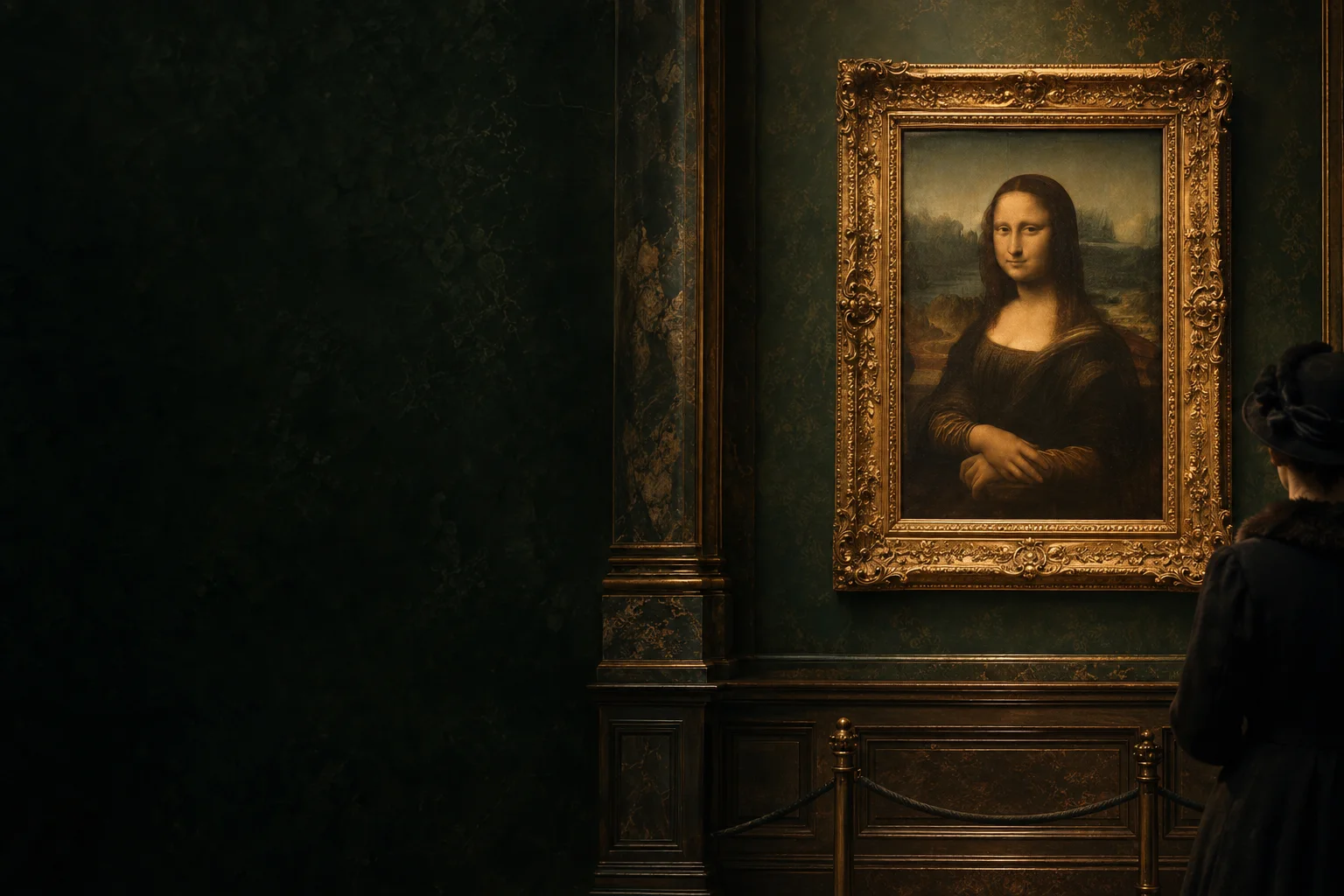
The empty wall
Explain why the day of a theft can differ from the day someone discovers it.
Read the storyEditorial illustration · not a historical source
Follow the evidence, beyond the frame.
Mission 1 · 6–12 minutes
Start the case
No account needed. Your work is saved in this browser; sign in any time to keep it in your account.
On 22 August 1911, the painter Louis Béroud found the Mona Lisa missing from the Louvre in Paris. Its place in the Salon Carré was empty. At first, there was confusion about whether someone had moved the painting to be photographed. That explanation could account for an empty wall. It could not account for what had actually happened: the painting had been stolen the day before. The theft took place on Monday, 21 August, when the museum was closed. The portrait was already centuries old. Leonardo da Vinci had painted it in the early sixteenth century. Now the question was not who had made it, but who had taken it and how a person could carry it out of the museum. Vincenzo Peruggia had worked at the Louvre and helped make protective cases for paintings. After his later arrest, he said he entered at around seven in the morning wearing a white work smock. His account describes lifting the Mona Lisa from four iron pegs, carrying it to a service stairway and taking off its case and frame. These are details from a later telling of the theft, not things Béroud watched happen. The distinction matters: finding the painting absent and describing its removal are different kinds of knowledge. The Louvre closed for a week while the disappearance was investigated. Closing the building did not bring the painting back. Nor did the report of an empty wall identify the person responsible. A missing object creates questions before it supplies answers. Was it still somewhere inside? Had someone who knew the building taken advantage of the closure? Which part of a witness's account described something they saw, and which part came from someone else's explanation? There are two dates to hold onto at the start of this case. The painting left its place on 21 August. Béroud first reported it missing on 22 August. Swapping those dates would make the story seem simpler, but it would erase the gap between the crime and its discovery. The first clue is that gap, not an invented scene of someone catching the thief. The painting would not return to the Louvre until 4 January 1914. That later ending will matter, but the case begins with the missing day between removal and report.
Words and phrases in context
Return to the sources
Sources and limits
Wikipedia: Mona Lisa
reference · Modern reference article; checked 2026-10-03
Wikipedia: Mona Lisa (new tab)A revisable reference synthesis, not a contemporary witness statement. Conflicting details are logged in the case research file.
Wikipedia: Vincenzo Peruggia
reference · Modern reference article; checked 2026-10-03
Wikipedia: Vincenzo Peruggia (new tab)A revisable reference synthesis, not a contemporary witness statement. Conflicting details are logged in the case research file.
Louvre: Salle des États — The theft of the century
institutional · Web publication date not stated; describes 21 August 1911 and a later recovery.
Louvre: Salle des États — The theft of the century (new tab)A modern institutional account; not an eyewitness record. Publication and rights review remain pending. Cited only by the French practice examples; the story uses the specified Wikipedia sections.