
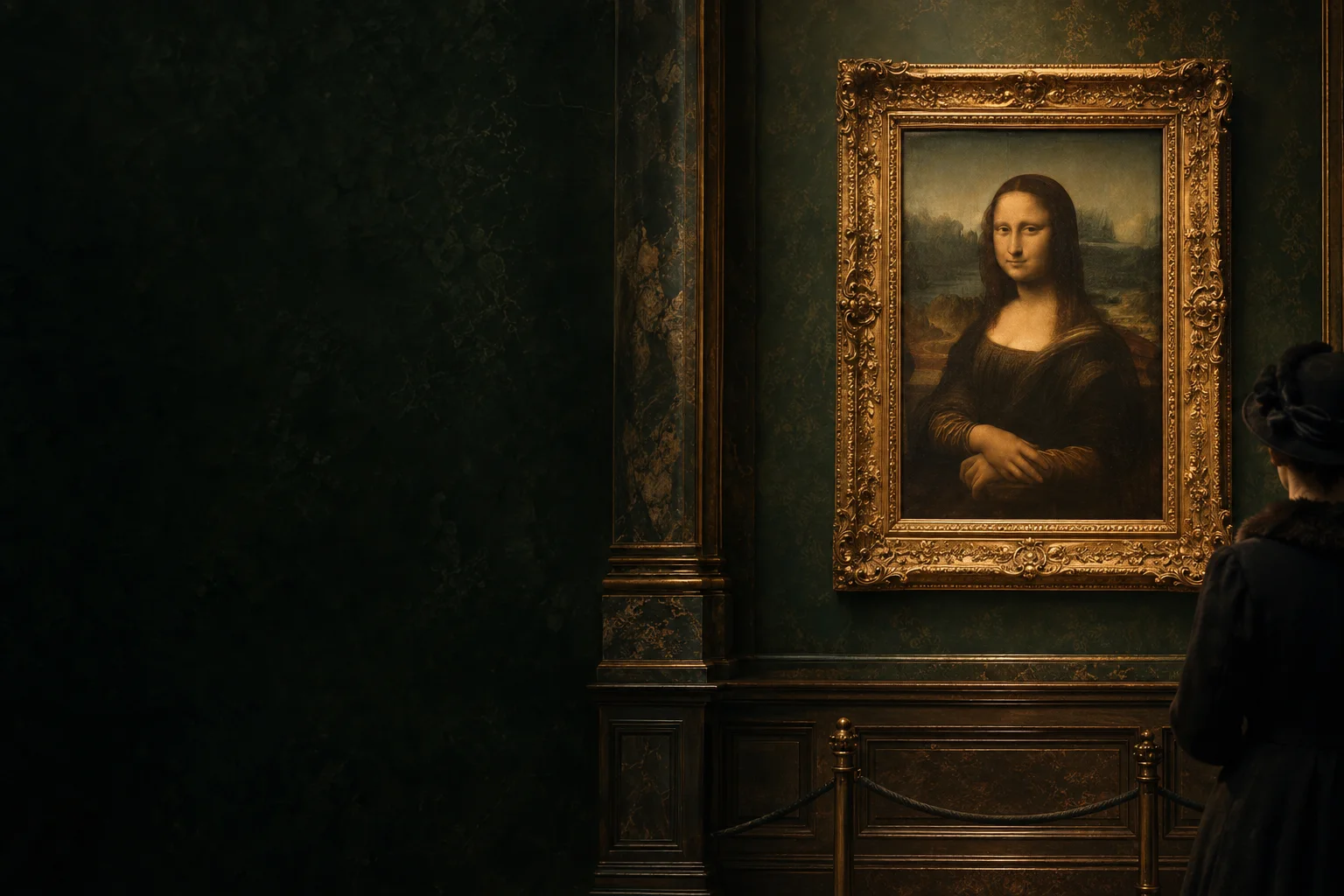
The wrong suspects
Distinguish an arrest, a connection to an earlier theft and proof of this theft.
Read the storyEditorial illustration · not a historical source
Follow the evidence, beyond the frame.
Mission 2 · 6–12 minutes
Start the case
No account needed. Your work is saved in this browser; sign in any time to keep it in your account.
On 7 September 1911, police arrested the poet Guillaume Apollinaire. The Mona Lisa had been missing since August, and another theft from the Louvre pulled his name into the investigation. Statuettes had been taken from the Louvre by a former secretary of his, Géry Pieret, some of them years earlier. The missing painting and the missing statuettes came from the same museum, but that did not make them the same crime. Pieret had stolen statuettes in 1907. The connection led police to people who knew him. Apollinaire named his friend Pablo Picasso, who had bought stolen statuettes from Pieret. Picasso was questioned about the Mona Lisa too. An old purchase could explain why officers wanted to ask questions. It could not, by itself, show who had lifted Leonardo's painting from the wall in August. Apollinaire was released within a week of his arrest. Both he and Picasso were cleared of involvement in the painting's disappearance. A story that stopped at the arrest would leave the wrong ending. A story that called Picasso the thief because he knew Apollinaire would make a different mistake: it would turn a connection between people into proof of an act. There was a genuine earlier theft here, so this was not a case of every suspicion coming from nowhere. The difficult part was deciding what that theft could explain. Buying a statuette, knowing its seller and stealing a painting are different actions. Evidence about one action must not quietly become evidence about all the others. The dates help keep those actions apart: statuettes in 1907, the painting in August 1911, Apollinaire's arrest in September. The statuettes are usually described as ancient Iberian stone heads, though one reference summary calls them Egyptian. That label does not change the outcome for the Mona Lisa suspects. The painting was still missing when Apollinaire left custody. Neither a well-known name nor an arrest had solved the crime. The story now has to return to the person who had worked around the painting itself: Vincenzo Peruggia.
Words and phrases in context
Return to the sources
Sources and limits
Wikipedia: Guillaume Apollinaire
reference · Modern reference article; checked 2026-10-03
Wikipedia: Guillaume Apollinaire (new tab)A revisable reference synthesis, not a contemporary witness statement. Conflicting details are logged in the case research file.
Wikipedia: Mona Lisa
reference · Modern reference article; checked 2026-10-03
Wikipedia: Mona Lisa (new tab)A revisable reference synthesis, not a contemporary witness statement. Conflicting details are logged in the case research file.
Wikipedia: Pablo Picasso
reference · Modern reference article; checked 2026-10-03
Wikipedia: Pablo Picasso (new tab)A revisable reference synthesis, not a contemporary witness statement. Conflicting details are logged in the case research file.
Wikipedia: Vincenzo Peruggia
reference · Modern reference article; checked 2026-10-03
Wikipedia: Vincenzo Peruggia (new tab)A revisable reference synthesis, not a contemporary witness statement. Conflicting details are logged in the case research file.
Louvre: Salle des États — The theft of the century
institutional · Web publication date not stated; describes 21 August 1911 and a later recovery.
Louvre: Salle des États — The theft of the century (new tab)A modern institutional account; not an eyewitness record. Publication and rights review remain pending. Not cited by the current English or French text; the story uses the specified Wikipedia sections.
Archivio di Stato di Firenze: I tentativi di vendita del dipinto
institutional · Modern exhibition page; documents dated 5 October/25 November 1913 and 2 April 1914.
Archivio di Stato di Firenze: I tentativi di vendita del dipinto (new tab)Exhibition summaries refer to interrogation records and letters. Reported motives remain attributed claims, not independent proof. Scans are not reproduced. Not cited by the current English or French text; the story uses the specified Wikipedia sections.